


Artificial Intelligence is reshaping industries worldwide, creating a massive demand for skilled professionals. This has made AI engineer jobs some of the most sought-after and well-paid positions in the tech industry. If you want to build a future-proof career, becoming an AI engineer is an excellent path forward.
This guide provides a complete roadmap to landing high-paying AI engineer jobs. We will cover everything from the core skills you need and the responsibilities you’ll have, to the tools you must master. You will also find practical advice on building a standout portfolio and preparing for interviews.
Table of Contents
What Are AI Engineer Jobs and Why Are They in High Demand?
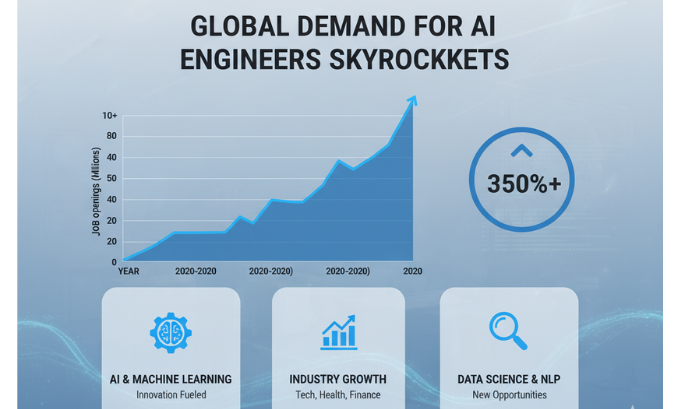
AI engineer jobs involve designing, building, and deploying Artificial Intelligence (AI) and Machine Learning (ML) models to solve real-world problems. The demand for these roles is soaring. AI-related job postings surged by over 25% in the first quarter of 2025 compared to the previous year, with median salaries reaching an impressive $156,998.
This growth is driven by companies across all sectors—from healthcare to finance—adopting AI to improve efficiency, create innovative products, and gain a competitive edge. AI engineers are the architects behind these transformative solutions, turning vast amounts of data into intelligent applications. They are not just coders; they are problem-solvers who bridge the gap between Data Science and software engineering.
The Role of an AI Engineer: A Day in the Life
An AI engineer’s daily tasks are diverse. They don’t just write code. A typical day might involve:
- Model Development: Designing algorithms for tasks like image recognition or natural language processing.
- Data Preparation: Cleaning, preprocessing, and structuring data to train models effectively.
- Training and Testing: Using frameworks like TensorFlow and PyTorch to train Neural Networks and validate their performance.
- Deployment: Integrating finished models into production systems so that users can interact with them.
- Collaboration: Working with data scientists, product managers, and other stakeholders to align AI projects with business goals.
Ultimately, an AI engineer ensures that AI solutions are practical, scalable, and create real value.
A Personal Journey: From Aspiring Coder to AI Engineer
My journey into AI began during my final year of college. I was studying computer science but felt something was missing. Standard software development was interesting, but the rise of Artificial Intelligence (AI) was too exciting to ignore. I saw how it was powering everything from Netflix recommendations to medical diagnostics, and I knew I wanted to be a part of it.
The first step was building a strong foundation. I dedicated months to mastering Python, not just the syntax, but its powerful libraries for Data Science like NumPy and Pandas. The real challenge, however, was mathematics. Concepts like linear algebra and calculus, which once seemed abstract, were suddenly crucial for understanding how Machine Learning (ML) algorithms worked.
I started small, taking online courses and working on projects from Kaggle. My first significant project was a sentiment analysis model that could predict the tone of customer reviews. It was a struggle. I spent weeks preprocessing messy text data and experimenting with different models. The initial results were poor, but each failure taught me something new. I learned about the importance of feature engineering and the nuances of training Neural Networks.
A breakthrough came when I started exploring Deep Learning (DL) frameworks. I decided to build an image classifier using TensorFlow and PyTorch. The goal was simple: train a model to distinguish between images of cats and dogs. This project forced me to understand Convolutional Neural Networks (CNNs). Seeing my model achieve over 95% accuracy was a moment of pure joy. It wasn’t just about the code; it was about creating something that could “see” and “understand” the world.
This project became the centerpiece of my portfolio. I documented every step on GitHub, explaining my methodology and the challenges I overcame. When I started applying for AI engineer jobs, this hands-on experience was what set me apart. Recruiters were less interested in my grades and more interested in my practical skills. My first role as a junior AI engineer was a direct result of the portfolio I had built.
What I Like: The Best Parts of Being an AI Engineer
- Impactful Work: You get to solve complex problems that have a tangible impact on businesses and society.
- Continuous Learning: The field is always evolving. You are constantly learning about new technologies like Large Language Models (LLMs) and advanced architectures.
- High Demand and Compensation: The demand for AI engineer jobs is incredibly high, leading to competitive salaries and excellent job security.
- Creative Problem-Solving: It’s not just about coding. It’s about thinking creatively to design intelligent systems from scratch.
Areas for Improvement: The Challenges of the Role
- Steep Learning Curve: Mastering the necessary math, programming, and theoretical concepts can be daunting for beginners.
- Data Dependency: The success of any AI project depends heavily on the quality and quantity of data, which can be a major bottleneck.
- Ethical Considerations: AI engineers must grapple with important ethical issues like bias, fairness, and transparency in their models.
- Keeping Up with the Pace: The rapid pace of innovation can be overwhelming. What’s cutting-edge today might be standard tomorrow.
Must-Have Skills for AI Engineer Jobs
To land competitive AI engineer jobs, you need a blend of technical expertise and soft skills. Here’s a breakdown of what employers are looking for.
Technical Skills
- Programming Proficiency:
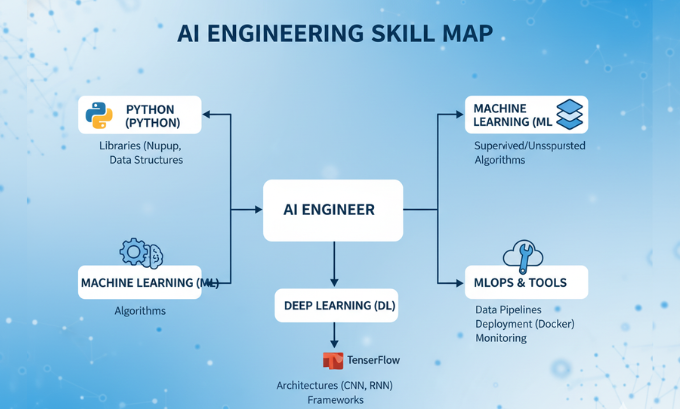
- Python: This is the undisputed king of AI programming. Its simple syntax and vast ecosystem of libraries make it the top choice. You must have a deep understanding of Python and its core data science libraries (NumPy, Pandas, Scikit-learn).
- Other Languages: Knowledge of R (for statistical analysis), C++, or Java can be beneficial, especially for performance-intensive or enterprise-level applications.
- Mathematics and Statistics:
- Linear Algebra: Essential for understanding how Neural Networks and other models process data.
- Calculus: Crucial for model optimization techniques like gradient descent.
- Probability & Statistics: The foundation for making predictions and understanding model uncertainty.
- Machine Learning and Deep Learning:
- ML Fundamentals: A strong grasp of supervised, unsupervised, and reinforcement learning is a must.
- Deep Learning (DL): Expertise in building and training Neural Networks is critical. This includes knowledge of architectures like CNNs (for image data) and RNNs (for sequential data).
- Frameworks: Hands-on experience with TensorFlow and PyTorch is non-negotiable.
- Data Science and MLOps:
- Data Handling: Skills in data extraction, cleaning, and preprocessing are vital.
- MLOps: Understanding how to deploy, monitor, and maintain models in production using tools like Docker and Kubernetes is becoming increasingly important.
Technical Skills Comparison
| Skill Category | Essential Skills | Why It’s Important |
|---|---|---|
| Programming | Python, NumPy, Pandas | The primary language and libraries for building AI models. |
| Mathematics | Linear Algebra, Calculus, Statistics | The theoretical foundation behind all ML algorithms. |
| Machine Learning | Supervised/Unsupervised Learning | Core concepts for building predictive and descriptive models. |
| Deep Learning | Neural Networks, CNNs, RNNs | Required for advanced AI tasks like computer vision and NLP. |
| Frameworks | TensorFlow and PyTorch | The industry-standard tools for building DL models. |
| Data Science | Data Preprocessing, Visualization | Prepares data for modeling and helps in understanding it. |
| MLOps | Docker, Kubernetes, CI/CD | Ensures models can be deployed and managed at scale. |
Non-Technical Skills
- Problem-Solving: AI engineers must be able to break down complex business problems and design effective AI-driven solutions.
- Communication: You need to explain technical concepts to non-technical stakeholders, such as product managers and executives.
- Domain Knowledge: Understanding the industry you’re working in (e.g., finance, healthcare) helps you build more relevant and effective models.
- Continuous Learning: The field of Artificial Intelligence (AI) moves fast. A passion for lifelong learning is essential to stay relevant.
How to Get Your First AI Engineer Job: A Step-by-Step Guide
Breaking into the world of AI engineer jobs requires a strategic approach. Follow these steps to build a strong profile and land your first role.
Step 1: Build a Solid Educational Foundation
A degree in Computer Science, Data Science, or a related field is a common starting point. However, a degree is not always a strict requirement if you can demonstrate your skills through other means. Focus on courses that cover programming, algorithms, data structures, and mathematics.
Step 2: Master the Core Technical Skills
Dedicate time to learning the essential skills listed above. There are countless online resources available:
- Online Courses: Platforms like Coursera, edX, and Udacity offer specialized tracks in Machine Learning (ML) and Deep Learning (DL).
- Certifications: Consider a targeted program like the Microsoft AI Engineer Program. These programs provide structured learning paths and hands-on projects, making you job-ready in a shorter time.
- Free Resources: Use platforms like Kaggle for tutorials and YouTube channels for visual explanations of complex topics like Neural Networks.
Step 3: Build a Project Portfolio
This is the most critical step. A portfolio of projects is tangible proof of your abilities.
- Start with Kaggle: Participate in competitions on Kaggle. It’s a great way to work with real-world datasets and learn from others in the community.
- Create End-to-End Projects: Choose problems that interest you and build a complete solution. For example, create a web application that uses a Machine Learning model you trained.
- Showcase Your Work: Host your code on GitHub and write detailed README files explaining your projects. A well-documented GitHub profile acts as your resume.
Step 4: Gain Practical Experience
- Internships: An internship is the best way to get real-world experience and learn from seasoned professionals.
- Open-Source Contributions: Contributing to open-source AI projects (e.g., on GitHub) is another excellent way to hone your skills and network.
Step 5: Network and Prepare for Interviews
- Optimize Your LinkedIn Profile: Highlight your skills, projects, and certifications. Connect with recruiters and professionals in the AI field.
- Practice Interview Questions: Prepare for both coding challenges and conceptual questions about AI, ML, and DL. Be ready to discuss your projects in detail.
Frequently Asked Questions (FAQ)
1. Do I need a Ph.D. to get an AI engineer job?
No, a Ph.D. is generally not required for most AI engineer jobs, especially roles focused on application and deployment. A bachelor’s or master’s degree combined with strong practical skills and a solid portfolio is usually sufficient. Ph.D.s are more common for research-focused roles.
2. What is the average salary for an AI engineer?
Salaries for AI engineer jobs are very competitive. In the U.S., the average salary is around $156,998 per year, but this can vary based on location, experience, and the company. Entry-level roles can start above $100,000, while senior engineers can earn well over $200,000.
3. Can I become an AI engineer without a computer science degree?
Yes, it is possible. Many successful AI engineers come from backgrounds in mathematics, physics, engineering, or even economics. What matters most is your demonstrated proficiency in programming (especially Python), Machine Learning, and Data Science. A strong project portfolio can often outweigh a traditional degree.
4. What is the difference between an AI Engineer and a Data Scientist?
A Data Scientist focuses more on analyzing data, discovering insights, and building prototype models. An AI Engineer takes those models and focuses on building, deploying, and maintaining them in production-level systems. AI engineering is more about software engineering and implementation, while Data Science is more about research and analysis.
5. How important are frameworks like TensorFlow and PyTorch?
Extremely important. TensorFlow and PyTorch are the industry-standard frameworks for Deep Learning (DL). Proficiency in at least one of these is a mandatory skill for almost all AI engineer jobs that involve building Neural Networks or working with Large Language Models (LLMs).
6. Where can I find datasets for my portfolio projects?
Kaggle is an excellent resource, offering thousands of public datasets across various domains. Other great sources include the UCI Machine Learning Repository, Google Dataset Search, and data published by government agencies.
Conclusion: Your Future in AI Starts Today
The field of Artificial Intelligence (AI) offers one of the most exciting and rewarding career paths in technology today. The demand for skilled professionals who can build and deploy intelligent systems is growing exponentially, and the opportunities for those who master the right skills are virtually limitless.
Landing one of the many available AI engineer jobs requires dedication, a passion for learning, and a focus on practical application. By building a strong foundation in Python, mathematics, and Machine Learning, and by creating a portfolio of real-world projects, you can position yourself as a top candidate in this dynamic field.
Ready to take the next step? Start by exploring a structured course like the Microsoft AI Engineer Program or dive into a hands-on project on Kaggle. The journey may be challenging, but the rewards—both personal and professional—are well worth the effort.
Author Bio:
Johnathan Archer is a Senior AI Engineer and tech writer with over a decade of experience in building and deploying large-scale machine learning systems. He specializes in natural language processing and computer vision and is passionate about making complex AI concepts accessible to a broader audience. Johnathan holds a Master’s degree in Computer Science and has worked with leading tech companies to develop innovative AI-powered products.
References:
- Veritone. “AI Jobs Growth: Q1 2025 Labor Market Analysis.” 2025.
- McKinsey & Company. “The State of AI in 2024: And a Half Decade in Review.” 2024.
- LinkedIn. “Fastest-Growing Jobs and Industries in the U.S.” 2025.
- Gartner. “Top Strategic Technology Trends for 2025.” 2024.
