


Are you interested in building the next wave of intelligent systems? An AI engineer course is designed to give you the technical knowledge and practical know-how to stand out in the future of tech. This guide answers what you’ll learn, how top courses compare, and how real-world skills from Artificial Intelligence (AI), Machine Learning (ML), and Data Science will accelerate your journey.
Table of Contents
What Is an AI Engineer Course?
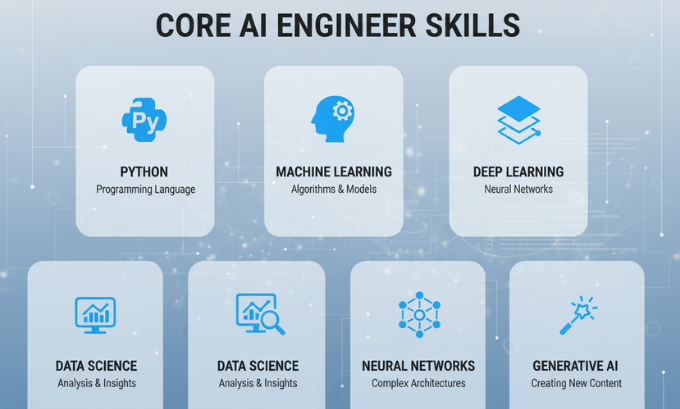
An AI engineer course is a focused training program that equips you to design, build, and deploy artificial intelligence models. These courses teach technical skills—like Python, machine learning, and deep learning—as well as practical experience in projects and modern AI tools.
Why AI Engineering Is the Future
Companies worldwide rely on AI for smart automation, predictive analytics, and innovations like ChatGPT and Generative AI models. Industry estimates say the AI market could top $825 billion by 2030. So, learning through an ai engineer course is the fastest way to make yourself valuable in this fast-growing field.
Core Skills You Gain in an AI Engineer Course
When you enroll in an AI engineer course, you’ll master these essential domains:
1. The Essentials of Artificial Intelligence
- Artificial Intelligence (AI) is about teaching computers to mimic human thinking and decision-making.
- In 2025, AI includes tools across three main types:
- Artificial Narrow Intelligence (ANI) for specific tasks (like voice assistants)
- Artificial General Intelligence (AGI), which is a theoretical future capable of human-like learning
- Artificial Super Intelligence (ASI), an advanced, speculative level beyond human skills
2. Machine Learning: The Core of Modern AI
Machine Learning (ML) is a branch of AI focused on creating systems that learn patterns from data.
An effective ai engineer course explains:
- Supervised Learning: Training with labeled data (e.g. image classification)
- Unsupervised Learning: Discovering patterns in unlabeled data (e.g. customer segmentation)
- Reinforcement Learning: Agents learn by receiving feedback/rewards (e.g. game bots or robotics)
3. Deep Learning: Powering Next-Gen AI
Deep Learning (DL) uses neural networks inspired by the human brain. They make advanced applications like speech recognition and natural language processing (NLP) possible.
Typical course modules walk you through:
- Building and tuning neural network architectures (CNNs, RNNs)
- Concepts of backpropagation, activation functions, and layers
4. Python Programming and Leading Libraries
Most AI jobs require strong Python skills.
You’ll practice with key libraries:
- NumPy for efficient calculations
- pandas for data manipulation
- Matplotlib for visualizations
- TensorFlow and PyTorch for building and experimenting with ML/DL algorithms
5. Data Science Foundation
AI engineers need to work with messy, real-world data.
You’ll learn:
- Data cleaning, wrangling, and exploratory analysis
- Using tools within Python for robust data processing
- Basics of data visualization for communicating insights
Real-World Experience: How an AI Engineer Course Makes a Difference
When I started learning AI, I bounced between tutorials and forums, but never made real progress until joining a structured course on Coursera, created by Andrew Ng, a leader in AI education. The step-by-step curriculum introduced me to foundational theory, but what truly transformed my skills was the hands-on approach.
Case Example:
I worked on an image classifier to distinguish cats from dogs. This project required:
- Writing a neural network from scratch with Python and NumPy
- Understanding how each layer learns from the data
- Debugging my own code, which deepened my technical confidence
Later, these core skills helped me explore Generative AI and even adapt transformers using Hugging Face models for chatbot projects.
Things I Appreciated About My AI Engineer Course
- Clear progression: Concepts built logically from basic to advanced
- Expert instruction: Teachers like Andrew Ng made hard ideas feel possible
- Practical projects: Each assignment was directly related to real-world use
- Peer community: Discussing challenges on Coursera forums and with peers kept me motivated
Areas for Improvement and Honest Observations
- Some lessons covering math or advanced neural networks felt rushed
- Deployment (MLOps) and production skills weren’t always covered in detail
- More exposure to frameworks like PyTorch alongside TensorFlow would have improved my versatility
More Than Machine Learning: The Modern AI Engineer’s Toolbox
AI engineering is more than classical ML. An up-to-date ai engineer course covers:
1. Generative AI: The Frontier of Creativity
- Generative AI models can generate new content: text, images, and even code
- Courses teach you the fundamentals of:
- Large Language Models (LLMs), such as ChatGPT
- Prompt engineering: Crafting requests for LLMs to get reliable, accurate results
- API integration: Connecting OpenAI (ChatGPT) APIs or Hugging Face endpoints into your own apps
- Tools like LangChain let you design flows that link models and data sources—this enables features like custom chatbots or automated code assistants
2. Hugging Face: Your ML Model Marketplace
- Hugging Face is the central platform for modern ML and NLP.
- With their transformers library, you can:
- Download thousands of pre-trained models
- Fine-tune them with your own datasets
- Share results or collaborate with the AI community
Scenario:
A business wants a chatbot that answers customer questions from its documents. Rather than building from scratch, you can use Hugging Face’s models and retrieval-augmented generation to quickly get high-accuracy answers tied to your unique data.
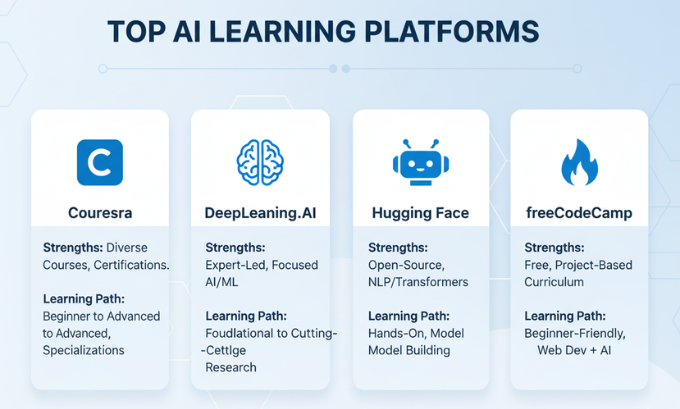
AI Engineer Course Platforms Compared
| Platform | Key Strengths | Example Instructor / Content | Cost Structure | Best Use Case |
|---|---|---|---|---|
| Coursera | Comprehensive, structured, university partnerships | Andrew Ng, Stanford | Free to audit, paid for certificates | Full career prep and theoretical depth |
| DeepLearning.AI | Modern topics, hands-on labs, quick skills | Andrew Ng, OpenAI Engineers | Some free, otherwise paid | Fast upskilling in new AI technologies |
| Hugging Face | Community models & data, collaborative projects | Industry experts, open-source | Free and open resources | Real-world NLP and deployment skills |
| freeCodeCamp | Project-based, accessible, flexible | Independent creators, educators | Always free | Building a strong coding foundation |
Tip: Many successful AI practitioners blend resources—using Coursera for depth, DeepLearning.AI for the latest tools, and Hugging Face for applied ML/NLP
Sample Roadmap: How to Master Artificial Intelligence (AI) in 12 Months
Months 1–3:
- Python fundamentals, data structures (NumPy/pandas), basic statistics and algebra
- Visualizing patterns with Matplotlib
- Recommended: “Python for Everybody” on freeCodeCamp
Months 4–6:
- Core ML: Regression, classification, supervised vs. unsupervised learning
- Introduction to classic algorithms (decision trees, SVMs, basic neural networks)
- Start building on Kaggle or via Coursera’s Andrew Ng ML specialization
Months 7–9:
- Deep Learning: CNNs, RNNs, key concepts in PyTorch or TensorFlow
- Image and language model basics
- Apply to simple projects: MNIST digit recognition, text sentiment analysis
Months 10–12:
- Advanced: Generative AI (LLMs, transformers), Hugging Face model tuning
- Integrating APIs (ChatGPT, Gradio, LangChain) into apps
- Create a capstone project such as a custom chatbot or recommendation system
AI Engineer Course – FAQ
Do I need a degree to start an AI engineer course?
No—a portfolio and hands-on skills are just as important as a degree. Many top engineers are self-taught and use certificates from platforms like Coursera or Hugging Face.
Which programming language should I learn first?
Python is the standard for ML, DL, and data science. Nearly all courses will teach you to use main libraries (NumPy, pandas, TensorFlow, PyTorch) from day one.
How long will it take me to get job-ready?
With steady effort, most people can go from beginner to entry-level in about 9–12 months. Actual time depends on your starting point and how many projects you complete.
How is an AI engineer different from a data scientist?
Data scientists focus more on data cleaning, analysis, and insights. AI engineers focus on building, scaling, and deploying learning systems—often in production or product environments.
Does Generative AI change what I need to learn?
Absolutely. Skills in prompt engineering, “retrieval-augmented generation,” and APIs are essential for creating smart, flexible AI-powered apps.
Can I learn AI engineering completely online?
Yes! The vast majority of top programs and all major tools (including those by Andrew Ng, Coursera, DeepLearning.AI, and Hugging Face) are available online.
Are free resources sufficient for building a career?
Free courses on YouTube or by Hugging Face/freeCodeCamp offer amazing value, but structured paths, assessments, and community feedback in paid courses can speed progress and improve your portfolio.
Conclusion: Your Next Steps in AI Engineering
An ai engineer course is your starting line for a high-demand, future-proof career. By mastering both the fundamentals—Python, machine learning, deep learning, and data science—and new frontiers like Generative AI and NLP tools, you’ll be positioned to solve challenges that matter.
- Use courses to structure your learning.
- Build projects to apply your knowledge.
- Stay curious, adapt to new frameworks, and join communities like Hugging Face for ongoing growth.
- Platforms like Coursera, DeepLearning.AI, and industry open-source hubs offer everything you need.
The future of technology will be shaped by those who understand and build with AI. Are you ready to get started? Pick the ai engineer course that matches your pace and style, and begin your journey today.
Author Bio:
Adel Nehme is VP of Media at DataCamp and an experienced educator in data science and artificial intelligence. With an MSc in Data Science and Business Analytics, he’s spent years creating understandable content and hands-on courses for learners worldwide. Adel regularly shares insights on AI, machine learning, and technology’s impact on society.
References:
- World Economic Forum, Future of Jobs Report 2023
- Statista, Artificial Intelligence Market Size Projections
- Glassdoor, AI Engineer Salary Data
- Coursera, Machine Learning Specialization by Andrew Ng
- DeepLearning.AI, Generative AI Course Catalog
- Hugging Face, Transformers Library Documentation
- Python.org
- Hugging Face Courses
