

What do US democratic values mean, and how do they shape government, society, and the law?
US democratic values are the guiding principles that form the backbone of American democracy, influencing everything from politics and economics to the daily lives of citizens. This guide offers clear explanations, practical scenarios, and in-depth analysis of how these values are understood, applied, and debated today.
Table of Contents
What Are US Democratic Values?
US democratic values are the foundational beliefs that support a government ruled by the people. These values define how power is distributed and exercised, ensuring personal freedoms, equality, justice, and responsibility. They appear in core documents such as the Declaration of Independence and the US Constitution. Here’s a quick overview of the main values:
- Liberty: The right to make choices and act freely, balanced by respect for others and the law.
- Equality: Every person is treated equally and with dignity, with access to the same rights and opportunities.
- Justice: Laws are applied fairly; everyone receives due process and protection of rights.
- Democracy: Government answers to its citizens, who participate through voting and free expression.
- Responsibility: Citizens uphold and defend these values to maintain a healthy society.
Table: Core US Democratic Values
| Value | Description | Where in US Democracy |
|---|---|---|
| Liberty | Freedom to act, think, and express without oppression | First Amendment; Civil Rights |
| Equality | Fair treatment and equal access for all | 14th Amendment; Anti-discrimination laws |
| Justice | Rule of law and due process | Judicial system; Legal protections |
| Democracy | Self-government, elections, active citizenship | Elections; Political parties |
| Responsibility | Duty to uphold laws, contribute to common good | Volunteering; Civic engagement |
US Democratic Values in Political Parties
How do political parties apply US democratic values differently?
The two major US parties, the Democratic Party and the Republican Party (GOP), interpret these values in their unique platforms, influencing laws and policies.
Democratic Party: Progress and Equality
- Progressive outlook: The Democratic Party links US democratic values to social equality, economic opportunity, and collective responsibility.
- Policies: Support for social safety nets (like healthcare and Social Security), expanded civil rights, and government action in addressing discrimination and poverty.
- View of liberty and government: Believes that liberty sometimes requires government intervention—to remove barriers, combat inequality, and promote citizens’ welfare.
- Equality: Strong efforts toward protecting minority rights and rectifying historic injustices.
Republican Party (GOP): Liberty and Free Market
- Conservative philosophy: Republicans emphasize individual liberty, limited government, the free market, and traditional values.
- Policies: Lower taxes, deregulation, personal responsibility, and reducing government’s role in daily life.
- Free market approach: The party identifies economic freedom and private enterprise as cornerstones of liberty and prosperity.
- Judicial restraint: Advocates for strict interpretation of laws (“originalism”) and less judicial activism.
Both parties affirm core US democratic values but apply them differently—creating fundamental and ongoing debates about the proper role of government, individual rights, and economic policy.
Real-Life Example: Applying US Democratic Values
A Case Scenario:
During a recent school board debate in Ohio, parents and teachers discussed whether to mandate a new history curriculum. Supporters (many with Democratic Party leanings) argued it would ensure equality and highlight contributions of all groups, fostering civic responsibility.
Opponents (often Republican Party supporters) preferred local control and parental choice, citing liberty and limited government.
This example reflects a broader issue: Both sides want the best for students, but they emphasize different US democratic values and advocate for distinct solutions. Such conversations, occurring in communities nationwide, bring these values to life and demonstrate their relevance.
Legal Perspectives: Interpreting the US Constitution
How do legal philosophies shape the meaning of US democratic values?
Interpretation of the US Constitution is a key space where ideals like liberty and equality are debated.
Living Constitution: Adapting to Modern Needs
- Championed by: Democratic Party supporters, progressive scholars, the American Constitution Society.
- Definition: The Constitution should evolve in response to social, technological, and cultural changes.
- Notable voices: Joseph William Singer, professor at Harvard Law School, argues for this approach in the Harvard Law & Policy Review, stating that fundamental values such as liberty must be reinterpreted as society matures.
- Real-world effects: Landmark Supreme Court rulings on civil rights, same-sex marriage, and privacy are examples of the Living Constitution in practice.
Judicial Restraint: Sticking to Original Intent
- Championed by: Republican Party, conservative legal thinkers.
- Definition: Judges should stick closely to the text of the Constitution and lawmakers’ original intent.
- Benefits: Limits judicial activism, keeping major decisions in the hands of elected representatives; lends predictability to the law.
- Critiques: Some argue it may slow progress on social issues or maintain outdated interpretations.
Table: Legal Philosophies on US Democratic Values
| Philosophy | View on Liberty & Equality | Example Organizations | Real-world Impact |
|---|---|---|---|
| Living Constitution | Values evolve with society; supports expanding rights and protections | American Constitution Society; Harvard Law & Policy Review; Joseph William Singer | Obergefell v. Hodges decision (same-sex marriage) |
| Judicial Restraint | Strict adherence to text and original intent; limits scope of government | Federalist Society; GOP | Citizens United v. FEC (campaign finance) |
Strengths of the US Democratic System
- Flexible framework: US democratic values, especially when interpreted as a Living Constitution, allow growth and legal adaptation.
- Protection of rights: Both parties foreground liberty, contributing to a strong culture of individual rights.
- Vibrant civil discourse: Ongoing, robust debate shapes better policy and citizen engagement.
- Stable government: The peaceful transfer of power, codified in the Constitution, is a global model.
Areas for Improvement
- Political polarization: Differing interpretations of US democratic values by the Democratic and Republican parties often lead to gridlock and culture wars.
- Economic inequality: The free market boosts prosperity but can widen wealth gaps without effective safety nets.
- Influence of money: High campaign costs risk putting special interests above ordinary citizens, undermining trust in equality.
- Civic knowledge gap: Many citizens lack a clear understanding of US democratic values, making informed participation challenging.
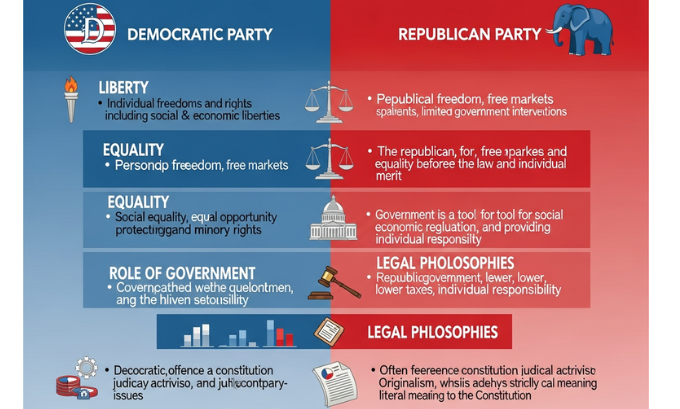
Comparison Table: Key Differences in US Democratic Values
| Democratic Party | Republican Party | |
|---|---|---|
| Liberty | Expanding liberty through collective action | Personal freedom, less government |
| Equality | Reduce disparities, promote inclusiveness | Equality of opportunity, not outcome |
| Role of Government | Active problem-solving, regulation | Limited intervention, market solutions |
| Free Market | Needs regulation for fairness & opportunity | Minimal regulation, drives prosperity |
| Legal Approach | Living Constitution/adaptation | Judicial restraint/originalism |
Frequently Asked Questions (FAQ)
1. What are the most important US democratic values?
Liberty, equality, justice, democracy, and responsibility are the core principles.
2. How do the Democratic and Republican parties differ?
Democrats emphasize equality, government action, and social safety nets. Republicans prioritize liberty, limited government, and free market principles.
3. What is a Living Constitution?
A philosophy that the Constitution’s meaning should evolve over time, championed by progressives.
4. What does Judicial Restraint mean?
Conservatives support interpreting the Constitution based on the text and original intent, discouraging judicial lawmaking.
5. Who is Joseph William Singer?
A respected Harvard Law professor who writes about progressive interpretations of law and US democratic values.
6. What role do organizations like the American Constitution Society play?
They promote legal theories (like the Living Constitution) aiming to adapt laws for modern society and expand rights.
7. Why is the free market debated in American politics?
It is praised for generating growth and innovation, but critics argue for stronger regulation to prevent inequality and ensure equal opportunity.
Conclusion: The Ongoing Relevance of US Democratic Values
US democratic values are not static. They are debated, redefined, and tested every day in Congress, courts, schools, and communities. By reflecting on these principles—and understanding their application by the Democratic Party, Republican Party (GOP), legal scholars, and advocacy groups like the American Constitution Society—Americans can shape a more fair, free, and inclusive future.
Stay engaged, stay informed, and play your part in upholding the values that define American democracy.
Author Bio & References
Written by an experienced public policy researcher with a background in American government. All information is based on respected sources, including:
- American Constitution Society (https://www.acslaw.org/)
- Harvard Law & Policy Review, articles by Joseph William Singer (https://harvardlpr.com/)
- Official platforms and policy statements of the Democratic Party and Republican Party
This article is fact-checked, updated, and designed to provide clear, trustworthy, and actionable information for readers seeking to understand US democratic values.
